
Alexander Kühn proposes a more transparent ITU with fair frameworks for global spectrum management

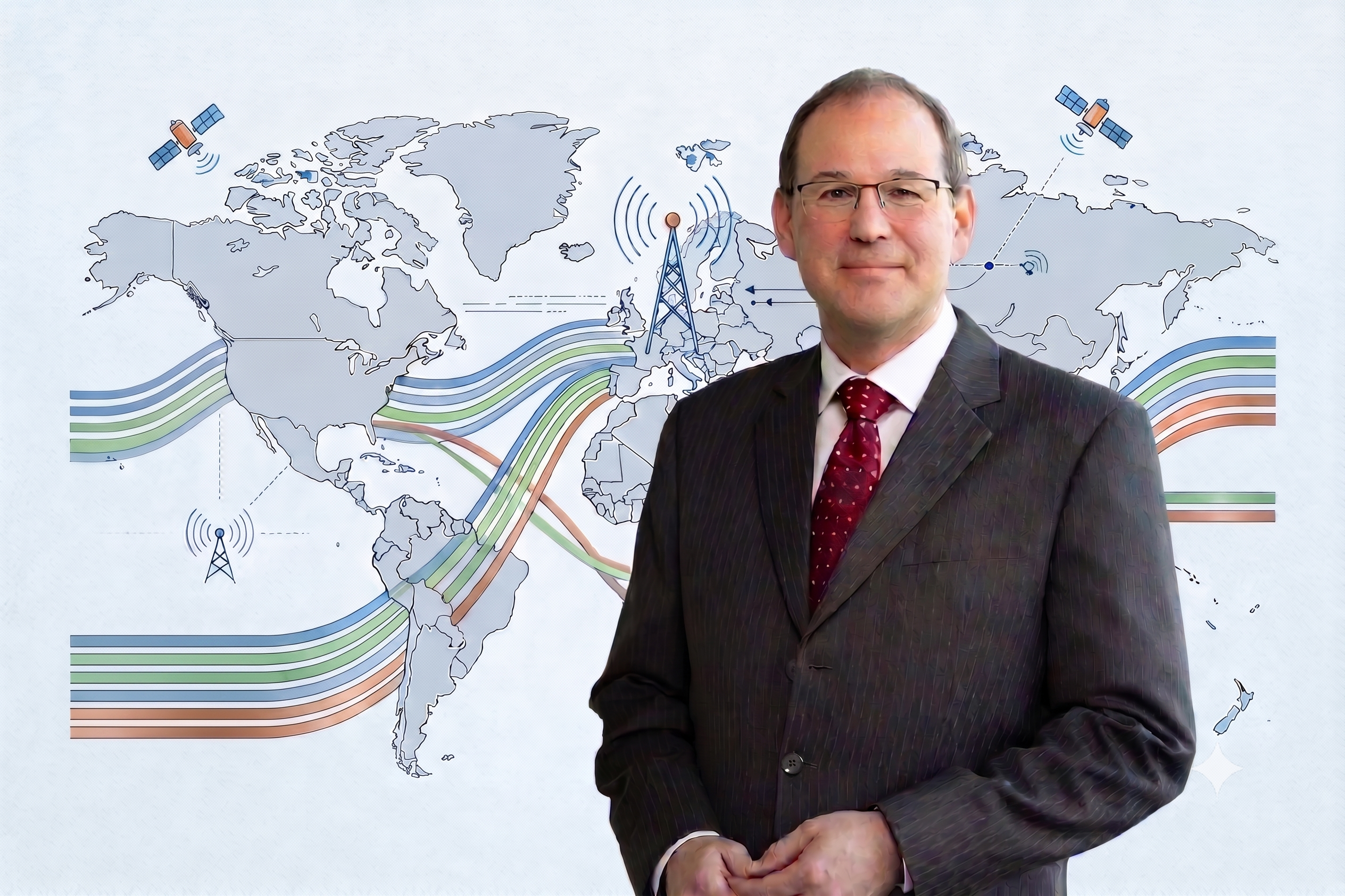
The candidate to head the ITU Radiocommunication Bureau proposes strengthening technical neutrality, transparency and evidence-based decision-making to ensure equitable access to spectrum in the era of 6G, satellites and D2D.
In November, during the Plenipotentiary Conference to be held in Doha, Qatar, the 194 member states of the International Telecommunications Union (ITU) will elect those who will lead one of the most influential bodies for the future of the digital economy.
Although the election takes place far from the media spotlight, its results will define the course of decisions that will impact the development of 6G, satellite networks, the Internet of Things (IoT), Artificial Intelligence (IA) and the connectivity of billions of people over the next decade.
In this scenario, Alexander Kühn, candidate to head the ITU Radiocommunication Bureau, proposes to strengthen the technical and impartial role of the Organization so that it continues to be the trusted referee in the administration of the most valuable resource for telecommunications: the radio spectrum.
In an interview with DPL News, Kühn stated that his goal is not to manage the office under a logic of continuity, but to strengthen its technical capacity and legitimacy in the face of an increasingly complex environment, marked by technological convergence and growing geopolitical competition.
“My ambition is not to simply maintain the Bureau, but to strengthen and actively develop it,” he said. “What I advocate is simple: technical excellence, evidence-based decisions, and greater transparency in the preparation of the World Radiocommunication Conferences.”
Increasing pressure on the spectrum
Never before has the Radiocommunication Bureau faced so many simultaneous challenges. The industry is defining the roadmap to 6G, operators deploy 5G-Advanced, Low Earth Orbit (LEO) satellite constellations increase their demand for orbital resources, and new technologies such as Direct-to-Device (D2D) begin to blur the lines between terrestrial and satellite mobile networks.
In parallel, technological rivalry between economic powers and the growing strategic value of the spectrum have turned the World Radiocommunication Conferences (WRC) into spaces where economic, industrial and geopolitical interests converge .
Given this scenario, Kühn argues that the Office’s main responsibility is not to decide who wins or loses a dispute over frequencies, but to ensure that Member States have independent technical analyses on which to build consensus.
“The Office does not impose regulations,” he explained. “My contribution will consist of robust and neutral compatibility and sharing assessments, presented with excellence, speed, and transparency, so that decisions are based on evidence and not on vested interests.”
The role as an impartial intermediary
With more than 20 years of experience in international regulation, Kühn currently heads the International and National Spectrum Management Division of the German regulatory agency BNetzA and chairs the ITU Preparatory Meeting for WMR-27, which has given him firsthand knowledge of the workings of the Radiocommunication Bureau.
His vision, however, goes beyond the technical component. Alexander Kühn believes that the ITU’s credibility will increasingly depend on its ability to maintain trust among regions with divergent interests and prevent geopolitical tensions from weakening the multilateral model that has allowed for the coordination of global spectrum use for decades.
Therefore, it proposes to strengthen the role of the Office as an “honest broker”, a neutral intermediary that facilitates agreements between all Member States.
“I want the Office to act as an impartial intermediary serving all Member States and regions, not as the voice of a single bloc or a single industry.”
Along the same lines, the expert argues that consensus building should not be understood solely as a negotiation tool, but as a leadership philosophy .
“Consensus and mediation are a leadership stance, not simply a negotiation technique.”
Predictable frameworks for connecting the disconnected
For Latin America, Africa, and other emerging economies, the spectrum discussion has implications that go far beyond technological innovation.
According to the ITU, 2.6 billion people remained without internet access in 2025. A significant portion of them live in developing countries, where spectrum is an essential enabler for expanding mobile coverage and reducing the digital divide.
Kühn believes that international regulation should create conditions that allow combining mobile networks, satellites and new connectivity architectures without generating regulatory uncertainty.
“Fair and predictable frameworks allow coverage bands, satellite services and direct device connectivity to work together with terrestrial networks to reach underserved areas,” he explained.
He also argued that countries with less technical or financial capacity should have the same weight in international discussions as large economies.
Equitable access to space
One of the debates that will mark the next decade will be access to orbital resources and frequencies used by mega-constellations of satellites.
Several developing countries have expressed concern about the possibility that large operators will occupy these resources first, limiting opportunities for future national or regional initiatives.
Kühn acknowledges that this concern is legitimate and maintains that the principle of equitable access, enshrined in the ITU Constitution, must continue to guide the Bureau’s actions.
“I take this concern very seriously and consider it legitimate. Equitable access is a principle enshrined in the ITU Constitution, along with the rational and efficient use of these resources.”
Institutional culture based on trust
Beyond the technical decisions, Kühn stated that the legacy he seeks to build is institutional.
If elected in Doha, he aspires to leave behind a more open, diverse Radiocommunication Bureau, prepared to train a new generation of spectrum management specialists, with greater participation of women and new leadership.
“I would like this to be based on a leadership culture that is open, honest, and transparent, one that unites people rather than divides them,” he said.
In a context where the radio spectrum is a strategic asset for digital competitiveness and technological sovereignty, the election of the next director of the ITU Radiocommunications Bureau transcends an administrative change.
The leadership that emerges from Doha will define how international consensus is built that will make it possible for 6G, satellite constellations, Direct-to-Device connectivity, and future Artificial Intelligence applications to coexist.
Alexander Kühn’s stance is that these decisions continue to rest on a principle that he considers indispensable to preserving the multilateral system: transparent, predictable and evidence-based technical rules.