
The magic of submarine cables in the modern world
Submarine cable infrastructure is essential to global connectivity, enabling a large share of the world’s telecommunications to be carried through these high-capacity, low-latency systems.

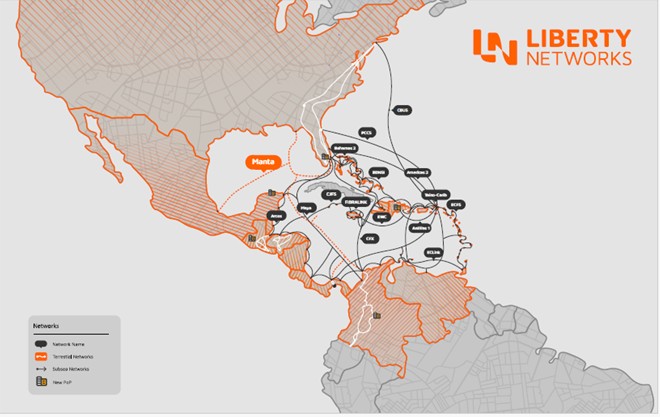 Liberty Networks’ Ecosystem
Ray Collins, SVP, Infrastructure and Corporate Strategy, Liberty Latin America
Have you ever wondered how you can connect to the digital world, play online with people around the globe, or complete electronic transactions instantly? For many, the obvious answer is “the internet,” but few stop to consider how that internet actually travels between countries and continents. The real magic behind connectivity lies in submarine cables. Without them, the global interconnection we take for granted today would not exist. A failure in these systems can quickly create widespread disruption.
In the early days of connectivity, “linking Europe and the Americas by telephone,” for example, required a cable (or more) between the two continents. Satellite connections came shortly thereafter, but they cannot keep pace with today’s data volumes and still depend on external factors such as weather, solar activity, latency, and more. The arrival of the internet changed everything: the volume of data to be transmitted grew exponentially, creating an even greater need for communication pathways. If we use an analogy from today’s world, data is like vehicles that require roads to travel and reach their destination. And we all know how frustrating it is to be stuck in traffic. To avoid this, “superhighways” have been built—routes where data can travel smoothly and reach its destination without congestion. This concept emerged many years ago through the same analogy, giving rise to the term “information superhighways.”
These “superhighways” are, for the most part, submarine cables. When people hear the term, they may picture a handful of fibers deep in the ocean without realizing that these cables are the invisible arteries of global connectivity—and essential for enjoying many of our favorite digital activities. They are also vital to countries’ economic development, as they enable a significant share of the world’s telecommunications to flow without interruption. In Central America, this is already becoming clear: El Salvador is moving toward its first international fiber-optic submarine cable, a system that will be built by Liberty Networks, with an approximate 1,800 km route that will connect the country directly to Panama, strengthening resilience and reducing reliance on regional terrestrial routes.
Cable technology has evolved dramatically since Europe and the Americas were first connected, and transmission speeds have grown exponentially. Today, our lives are more connected than ever: video calls, social media, remote medical services, artificial intelligence, the internet of things, and more. All of this digital activity depends on physical infrastructure that is as complex as it is essential: submarine cables and data centers. Keeping them operational, secure, and up to date carries a cost that is as high as it is indispensable.
Submarine cables transmit data through optical fibers, protected by multiple layers of durable materials to ensure performance in the marine environment. However, the ocean floor can be unpredictable, and these systems remain exposed. Earthquakes, ship anchors, volcanic activity, or even routine fishing accidents can damage cables. When that happens, repairs must be carried out by specialized vessels that locate and fix the fault—often at a cost of millions of dollars. In addition, emergency redundancy plans are implemented as needed to preserve service continuity. Few companies can do this, and Liberty Networks is one of them.
Once data emerges from the ocean, it travels to massive data centers on land. These facilities house thousands of servers that store, process, and distribute the information we use every day. Their operation requires constant cooling systems, redundant power sources, physical and digital security, and frequent technology refresh cycles.
The service quality that users and markets demand—speed, 24/7 availability, and zero interruptions—requires telecommunications companies such as Liberty Networks to continuously maintain and scale their infrastructure. In a context where data traffic is increasing due to the growth of 5G, artificial intelligence, quantum computing, cloud, and remote work, infrastructure must not only be maintained but also anticipate future needs.
Long-Distance Innovation
At the core of the cable are optical fibers, made of glass or plastic, which carry data as pulses of light, enabling high-speed transmission. The cable includes devices that amplify optical signals, ensuring data can travel long distances without degradation. The ends of the cable connect to shore-based landing stations, where power for signal amplification is supplied and where traffic is distributed across local and global networks, allowing continents and countries to interconnect.
Submarine cable infrastructure is critical in regions such as Latin America because it enables long-distance data transmission, interconnecting the world through the sea, creating greater opportunities, and facilitating economic and technological progress for developing countries. For this reason, most countries in the Latin American and Caribbean region have one or more shore-based landing stations. These are strategic connection points for this infrastructure, enabling the flow of advances in connectivity and digital content to and from Latin America.
In this landscape, Liberty Networks has focused on strengthening connectivity in Latin America through strategic actions, including a US$250 million investment in submarine cable and data center infrastructure. This five-year plan, launched in 2023, aims to expand terrestrial and subsea network infrastructure to improve digital access, expand data centers, and deliver advanced enterprise solutions across the region.
The company recognizes the importance of submarine cabling for the region’s connectivity and, for many years, has been dedicated to developing the most advanced fiber-optic technology infrastructure in Latin America and the Caribbean. With nearly 60,000 kilometers of submarine fiber-optic cable and 28 terabytes (TB) of lit capacity, Liberty Networks enables monumental data transmission, connecting over 30 countries.
Liberty Networks operates one of the most extensive broadband networks in Latin America and the Caribbean. As part of its expansion strategy, the company has established partnerships to accelerate the development of these networks. The company recently announced a significant expansion of its network coverage by activating two new Points of Presence (PoPs) in Mexico and upgrading an existing PoP in Peru. These strategic improvements will provide local businesses, carriers, and government institutions with high-speed IP transit, robust DDoS protection, and MPLS and Ethernet services, enabling them to scale operations, improve performance, and connect seamlessly to global networks. With these additions, Liberty Networks now has 96 wholesale PoPs across Latin America and the Caribbean.
In addition, in partnership with Gold Data, Sparkle, and SubCom, a new pan-regional submarine cable system, MANTA, is being developed to connect Mexico and the United States with Latin America. The MANTA system aims to improve data traffic flow in the region by providing new high-capacity. These low-latency routes interconnect key data centers in Mexico City, Querétaro, Bogotá, and Panama City with the United States, using new access points in Veracruz (Mexico) and San Blas (Florida).
In conclusion, Submarine cables are the silent infrastructure that sustains the modern digital world. Beneath the ocean’s surface lies the network that makes global communication, digital commerce, innovation, and knowledge exchange possible at a scale never seen before. Every video call, financial transaction, cloud service, or emerging technology ultimately depends on this physical foundation of global connectivity. As digital demand accelerates and new technologies reshape economies, the importance of resilient, high-capacity subsea infrastructure will only continue to grow. Through sustained investment, technological innovation, and strategic partnerships, Liberty Networks is helping ensure that Latin America and the Caribbean remain strongly connected to the global digital ecosystem, enabling opportunity, progress, and long-term digital development across the region.